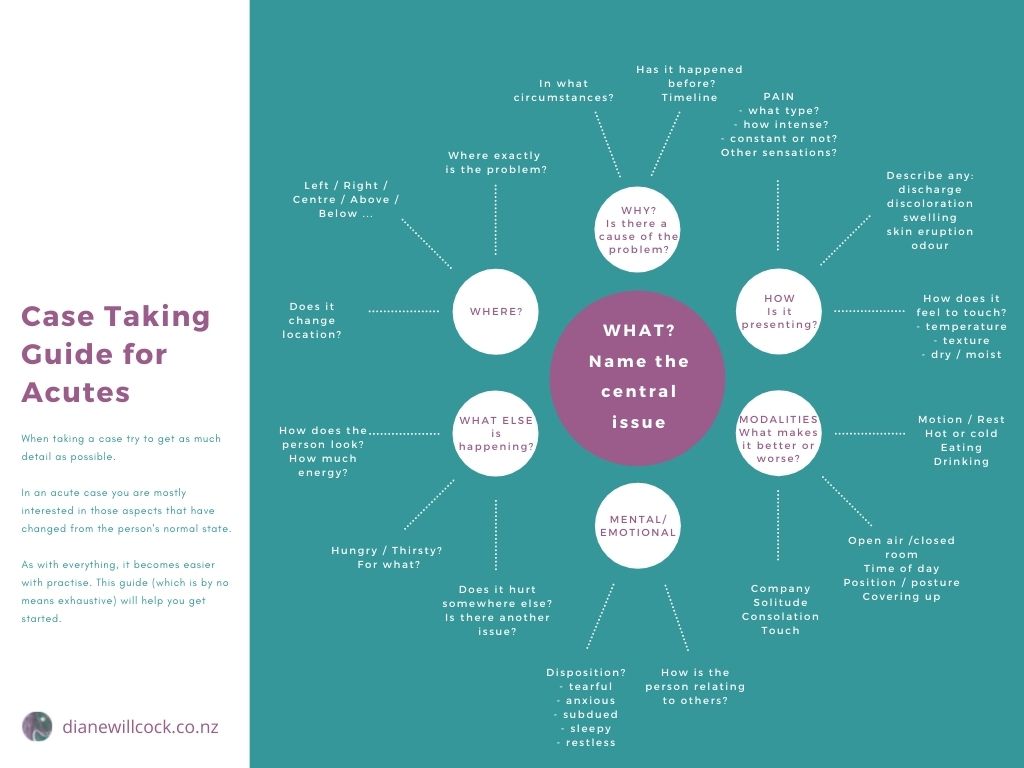

So you know which remedy to give, now what? One of the hardest things for the home-prescriber (& sometimes the homeopath too) is knowing what potency and how often (we call this posology).
The Train Analogy
An analogy for homeopathy that I like is the runaway train. It is also helps to explain the posology.
There are a number of ways to stop a runaway train on a single track.
One is to send another train on the track in the opposite direction to meet it head on - works but could be messy. This is a bit how conventional medicine works with ANTI-biotics, ANTI-depressants, ANTI-hypertensives etc.
Another is to send the rescue train along the track behind the runaway. The rescue train has to first speed up to reach the runaway, couple to it and then slow both down to a gentle halt. This is how homeopathy works - gently and in the same direction.
With this general background, we can make some sense out of prescribing homeopathic remedies in acute situations.
First choose a potency - How intense is the situation? How fast is the runaway train?
Most home-prescribers will be using lower potencies like 30C which is generally appropriate. However in a more intense situation such as a Belladonna fever, 200C would be better.
Second - how often? Again, it depends on the situation. How fast is the runaway train and how far away is it? At the beginning of dosing, repetitions will be needed more often as the rescue train catches up. But once the rescue train has coupled on and started to slow, the intensity of the situation eases. Doses will be needed less and less often until not needed at all.
At any time during the process, the situation is monitored and dosing adjusted to match.
A General Guide
A rule of thumb for frequency of dose in acute situations is
One dose every 2-4 hours for 24 hours.
This is a starting point only - in very intense situations a dose every five minutes may be needed.
The intensity of the situation will also indicate a suitable timeframe for assessing if the remedy is working. If no progress is apparent after about four to six doses, a new remedy (or potency) needs to be selected.
In acute situations it is better to err on the side of one or two too many doses rather than too few.
Remember: If at any time the situation is outside of your ability, seek professional health.
In an emergency, call emergency services.
Free Case-Taking Guide
Fill in your name and email and receive a guide for acute case taking